Saturday, 19 March 2011

Fundraising efforts

I know many of you have already made donations and for that we are forever grateful.  To anyone who still wishes to make a donation, please consider the JCCC Foundation's Earthquake Relief Fund.  I believe the JCCC's reputation speaks for itself and my family and I can personally vouch for their integrity.  

With gratitude and appreciation,
    Kristin


http://www.jccc.on.ca/japan_earthquake_relief_fund.htm


Friday, 18 March 2011

Why I'm proud to be Japanese-Canadian

As I posted last week - it seems like eons ago now - my trip to Japan was, first and foremost, a way for me to experience first-hand what it means to be Japanese, because I already know what it means to be Canadian.  When we first got there, it was a little bit of a culture shock at first, not because we felt like outsiders but because we were in awe of how orderly, polite, and methodical the Japanese people are.

They rely heavily on their extensive subway and rail systems to commute to and from work, so their train stations operate at a significantly higher volume than anything you or I would ever experience in Canada, even at it's peak I read that Toronto's Union Station accommodates about 200 000 passengers a day.  Shinagawa Station accommodates on average 1million commuters a day, and over 1.2million people pass through Tokyo Station in any given day, being Tokyo's main hub with over 3000 subway, JR line, and Shinkansen trains making stops there.


So imagine that kind of volume in North America.  I don't know about you, but all that comes to mind when I try to picture that many people trying to catch a train here is madness.  Complete and utter chaos.  But in Japan, that is not the case.  Even during the quake, people were obviously confused and concerned but even through everything that was going on, they were calm, organized, and methodical.  In the 5+ hours it took us to walk from Asakusa to Shinagawa, we saw more and more people evacuated from their buildings and flooding out of the closed train stations, all of them forced out into the streets of Tokyo.  Even then, with likely 4 million people trying to get home, there was still no evidence of chaos.  Line-ups for busses spanned entire city blocks, 1000 people long, but the displaced commuters waited patiently, without pushing and shoving, resigned to wait their turn in line knowing that they were all in the exact same situation.


All of these examples of Japanese culture only solidifies my respect for their customs.  I was constantly in awe of how strong, poised, and proud they are in every aspect of their lives. 

I think my visit to Mount Fuji was a pivotal point in our trip.  I said in an earlier post that standing up on that mountain, I felt entirely insignificant.  And I don't mean that in a negative way, it was more so that my problems and worries seemed so far away compared to what was going on all around me as I stood up there 2020m above sea level, staring out at the countryside from halfway up the tallest mountain in Japan... I gained a sense of perspective that I hope I will carry with me for the rest of my life.


I talked to a lot of friends before I left for Japan, and they all kept telling me that I was going to get there and that I would feel the spirits of my ancestors all around me, that I would fill the missing void in my life that I might not have even known was missing in the first place.  I won't lie, a small part of me rolled my eyes and thought "yeah, right..."  But I understand that now.  It wasn't a 'Eureka' moment where I felt a sudden rush of Japanese spirit, that only happens when I drink sake.  Instead, I don't think it even hit me until I came home, and I realized that the reason I felt so safe and so secure there was because I felt like I was a part of the very fabric of Japan herself.  I felt a sense of belonging there that I only ever feel in a handful of other places in the world (the JCCC being one of them).  And it wasn't because I felt like my ancestors had embodied my spirit or anything like that, I just saw so much of myself in the people around me, and so much of my family in them too.  I felt connected to them through cultural similarities that I never knew existed, and at that moment I finally understood why the JCCC's motto is "friendship through culture".  I might be 4th Generation Canadian but I am very much a JAPANESE-Canadian at heart.  It may have taken me 25 years to fully appreciate it but the important thing is that I have finally embraced that part of my life that has laid dormant for so long and I never want to give it up.

Mom and I at Haru Matsuri at the JCCC, March 5/11

Wednesday, 16 March 2011

Narita campgrounds...

Wanted to share these photos with you quickly before I try to get some sleep.  Been a long day, feels so surreal now that we're home and back to our routine (even my two aloof cats have been unusually cuddly tonight). 

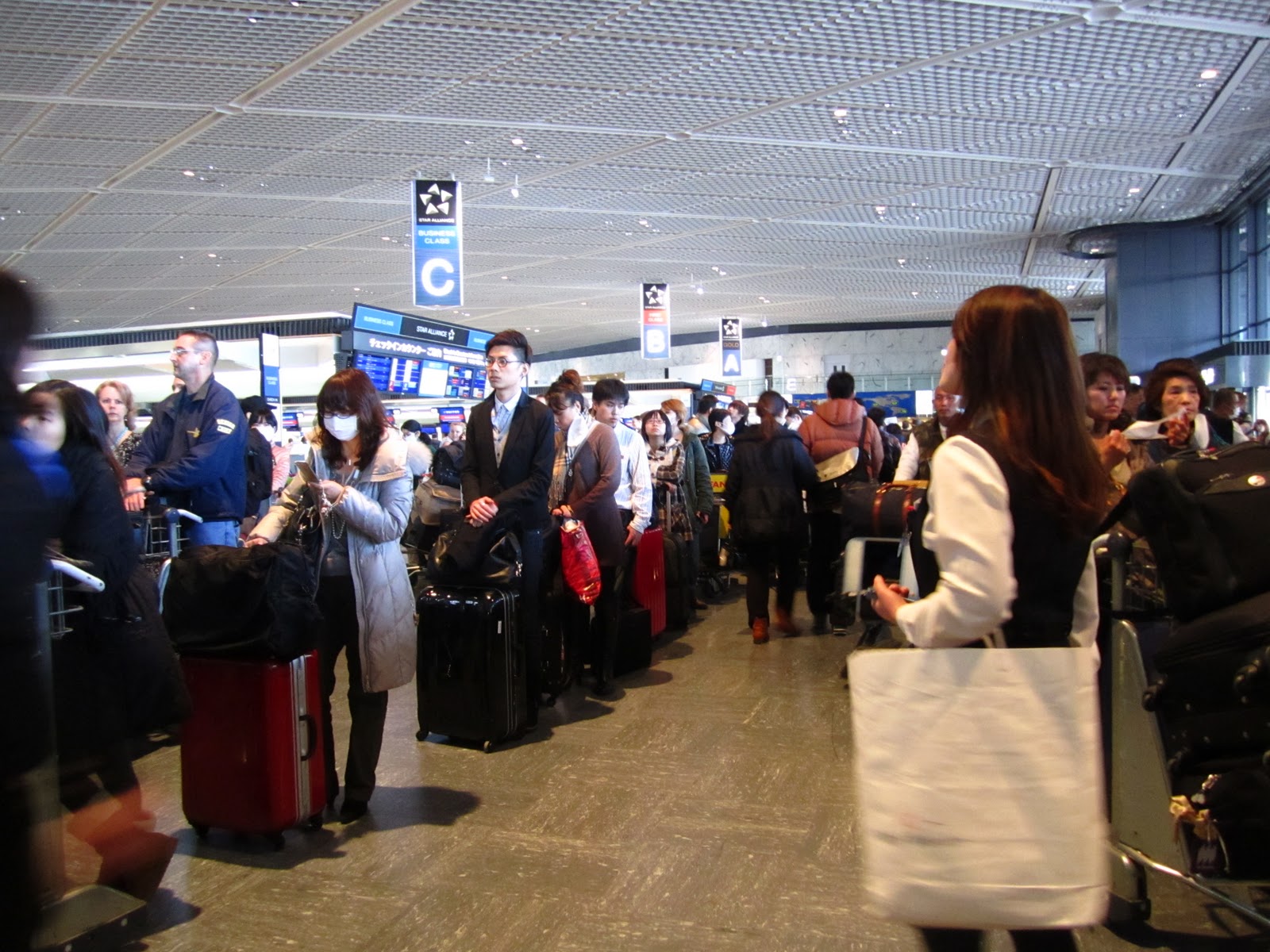
As crazy as the line was going through Canadian customs tonight, I think the lines at Narita are the biggest I've ever seen at an airport, and I've spent a lot of time in busy airports flying during peak seasons (spring break, march break, Christmas holidays).  The stark differences between Pearson and Narita are incredible though.  For one, although Narita had thousands of people crowded in there, it was organized madness.  There was no pushing, shoving or yelling.  There was airport personnel everywhere, and wherever there wasn't an airline employee there was a policeman answering questions.  People stood patiently in lines of well over 100, some of whom I overheard saying they had been there for hours already.  Even while aftershocks rattled the building, everybody stayed calm and collected and the general feeling seemed to be that of relief - maybe relief to be going home, or relief that the buildings were still standing... whatever it was, I felt a great sense of security being there knowing that the last leg of our journey was almost over.

Here are some photos from Narita, it's hard to tell just how many people were there but the lines went from one end of the terminal to the other.  Some were lines to check in for flights, but most seemed to be lined up to buy tickets, which were hard to come by as you can imagine.  There were people camped out in the hallways with their sleeping bags laid out and their cell phone chargers plugged into the walls (of course!), entire families of grandparents and small children, all of them seemingly just hanging out, "just in case" they need to get out of Japan in an hurry.  The airport itself seemed to be operating normally, the only evidence of the earthquake were the pylons blocking off areas under skylights, air vents, and other loose panels that could fall out of the ceiling and injure someone should the building shake too violently.  We did notice that the duty free shops all closed early, 6:30pm, I think because of the power restrictions but I'm not entirely sure.  We saw lots of signs in store windows in Tokyo reducing their business hours from 8:30am-11pm to 10am-6pm, even McDonalds had a sign up that they were closing early.


Fixing a broken water main in Tokyo
Packed and ready to go

There were more people camped out around every corner, upstairs, downstairs...


Terminal 2, South Wing

Keeping a close eye on the news

Sign said "Watch Your Head"


Home in Toronto

So a lot has transpired since my last update. For one, we're back in Toronto now. Been in transit for a cumulative 25hours so far, left our hotel in Kyoto Wednesday morning at 6am (5pm Tuesday EST) and we're just now in the customs line at Pearson. We still maintain that we felt "safe" when we left, although in the 6hours we were at Tokyo's Narita airport, we felt many more aftershocks, some of them strong enough to shake the building and delay all flights.

I can say that we're relieved to be home safely, but we also left such a huge part of us behind. My heart is definitely still in Japan with the Japanese people and their beautiful country.

Tuesday, 15 March 2011

Aishiteru, Kyoto

It's really late here and we have an early start tomorrow so no update tonight but wanted to share some photos from our day here in Kyoto.  It is so beautiful here it brought me to tears, words cannot express how incredible this country is, I fall more and more in love with her everyday.  I only wish there was more we could do to help those in need. 

I urge anyone and everyone who is able to help to please donate to the Red Cross or other relief organization of your choosing, because Japan needs your help now more than ever.  But might I also leave you with a note of caution as well - be careful who you are giving your money to.  I would not recommend giving money to non-registered charities or individuals claiming to be collecting money on behalf of an organization.  Please see the following link for more tips on how to choose an appropriate charity.

Kinkakuji Temple

Kinkakuji grounds


An early bloom
Ryoanji Zen Rock Garden, one of the most peaceful places on earth

Monday, 14 March 2011

Fujiyama/Hakone


We’ve had some time to settle in so now I can do a proper update of our most recent adventure.  We had an early start in Tokyo, heading out on our full-day tour of Fujiyama (Mount Fuji) and Hakone.  All the other Sunrise tours out of Tokyo were cancelled indefinitely, except for our specific tour.  Even still, 7 out of 22 people registered for the tour didn’t show up.  Our tour guide was a funny little lady, Amy Nakamura, she provided us with endless hours of entertainment during the long bus rides between Tokyo-Fujiyama, and Fujiyama-Hakone.

Nakamura-san came prepared with diagrams, photos, activities, etc

Anyone recognize the tower from Lost in Translation?
 The drive to our first stop in Fujiyama took about an hour and a half, during which time I don’t think Nakamura-san stopped talking.  She even taught us the famous Japanese children’s song, ‘Fuji no yama’ (Mount Fuji Song) that all Japanese children learn in school.  I liken it to the ‘Provinces of Canada’ song that I learned at age 5.  

One of the spectacular views of Mt. Fuji from the bus

Our first stop was at the Mount Fuji visitor’s centre at the base of the mountain.  As with most of the other tourist attractions, only the snack bar was open and nothing else. We were a little disappointed that the amusement park nearby was closed, they have the world’s longest roller coaster there, right at the base of the mountain.  They even have a Thomas the Tank Engine land for the kids, haha!  Some of the names of the rides made us laugh – ‘The Great Fluffy Sky Adventure’, ‘Rolling Wave Ham Ship’, and ‘Death Penalty Manor’, to name a few.

Mt. Fuji with the amusement park in the foreground
Might look like a backdrop, but that's Mt. Fuji in all her glory
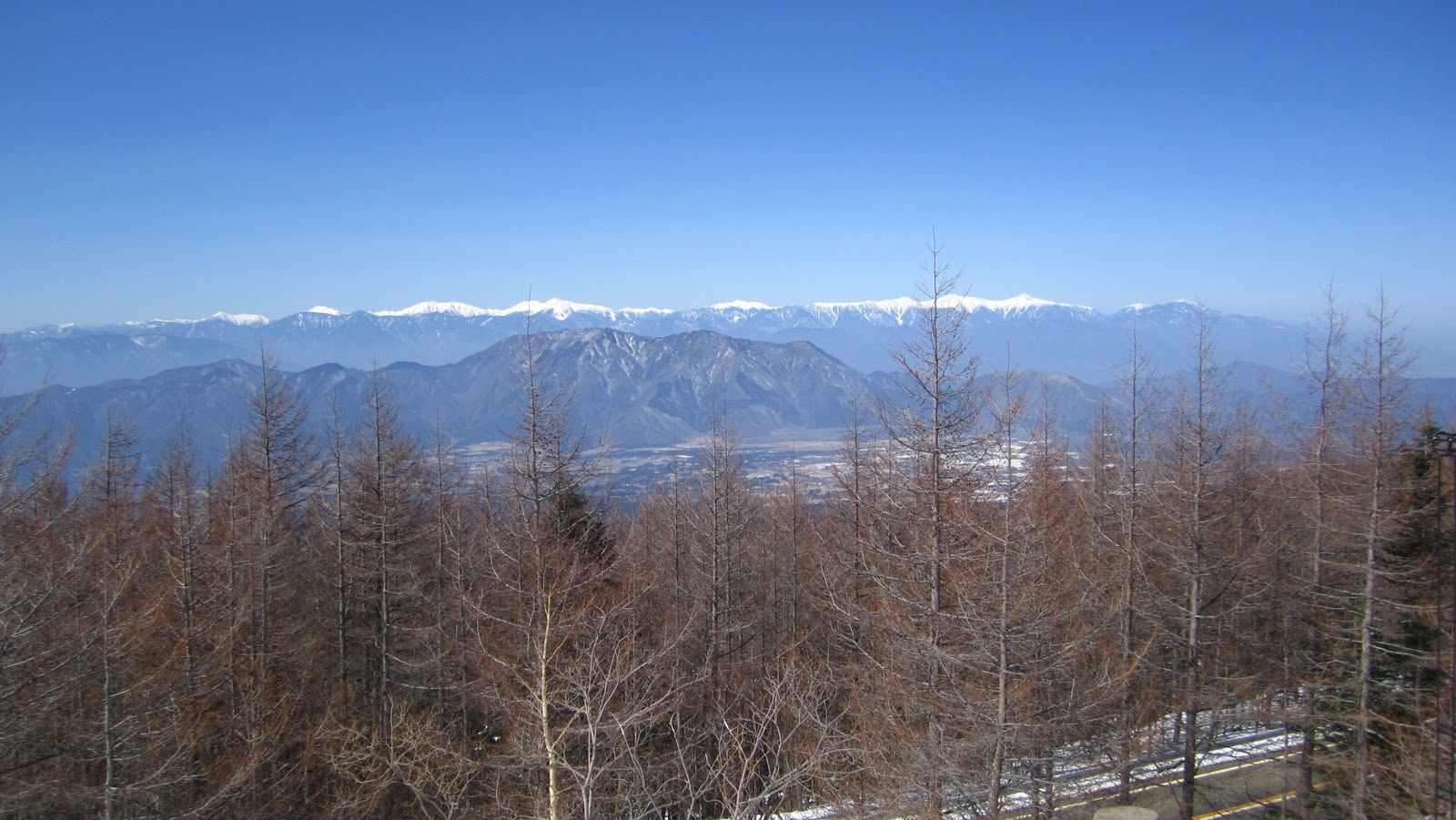
From there we headed up the mountain to the 5th station, which was 2020m above sea level.  It was quite cold up there, maybe -2’C (which was nothing to us Torontonians).  Nakamura-san told us that the weather dictates how far up the mountain you can go, because snow and ice could block the roads, and poor visibility limits vehicle traffic.  We were really fortunate to have a beautifully sunny and clear day; we could see the peak of Mount Fuji even from far away, and from the 5th Station the Japanese Alps lay before us, extending as far as the eye could see.  It was truly spectacular.  It made me feel entirely insignificant as I stood there taking in the breathtaking view - peaceful, still, quiet  - merely 300miles away from the devastation in Sendai.  

Taken from halfway up Mt. Fuji with the Japanese Alps behind us
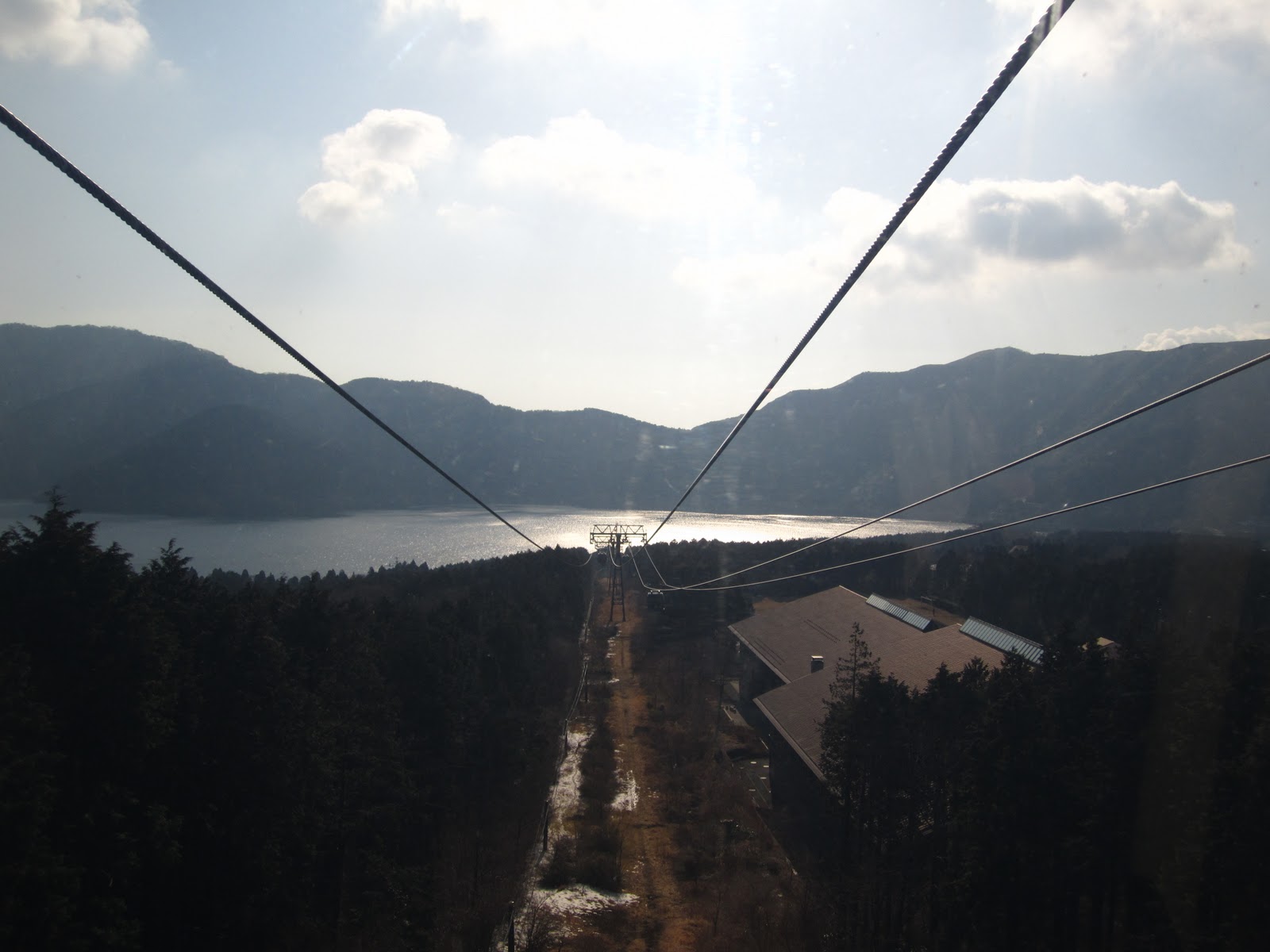
 Headed to the Ropeway next.  The Komagatake Ropeway at Lake Ashi was closed, so we went up the Hakone Ropeway instead.  We could see both Mount Fuji and Lake Ashi from the cable cars, and the highest station we could reach was situated at around 1227m above seal level.  They had hard-boiled Kuro-Tamago (Black Eggs) there, a local specialty.  The eggs turn black because of the high sulphur and iron levels, and they are naturally boiled in the hot springs.  They also give off a pretty potent odour.

On the Hakone Ropeway, with Lake Ashi down below and Mt. Fuji to the right of us (not pictured)
The cruise on Lake Ashi was a little chilly and windy, but the view was second to none.  We found out later that Hakone is a sister city to Jasper National Park, which makes total sense although Lake Ashi reminded me a lot of Lake Louise. 

The view from the upper deck of our ship with the Wishing Bell in the foreground

Hard to believe this is the same country that was just ravaged by a record-breaking natural disaster
The bus dropped us off in Hakone before heading back to Tokyo because we requested to stay overnight in a Ryokan, or traditional Japanese inn.  The walk from the bus terminal to our hotel, ‘Hakone-ji Kaiun’ was easy because the narrow streets ran alongside the river which was lined with beautiful greenery and even some blooming sakura (cherry blossom) trees.  They didn’t speak much English there, but we were able to check in with only a little bit of difficulty.  Our first indication that we weren’t in a big city anymore was the room key… it was a physical key on a large wooden keychain.  Dad laughed and commented that he doesn’t think he’s seen anything other than an electronic keycard used at a hotel in more than a decade.  The funniest part of it was that we didn’t realize until this morning when we got back from breakfast that not only do you have to use the key to unlock the door, you have to lock the door behind you when you leave!  We felt really silly because it never even occurred to us to lock it behind us!


The highlight of our trip so far was enjoying the traditional kaiseki dinner that they served us at the Ryokan.  Meals at Ryokan resorts are usually served in the guest-rooms on tatami mats, but at this particular Ryokan they had a communal dining room, with a reserved table for each room.  Our server was so nice, she even took our menu to the back with her and tried her best to translate the names of the dishes into English for us.  

Only the first course of many at the Hakone-ji Kaiun Ryokan

We were a little embarrassed at first because we wore our yukata to dinner (a casual cotton kimono), and there were only 3 other people wearing them but it didn’t feel right to wear street clothes when even our servers were wearing kimono.


Breakfast was served in the same dining room, I could definitely get used to these Japanese breakfasts.  Some of the dishes offered included gohan (rice), miso soup cooked in a hot pot right on the table, a local fish grilled over an open flame at the table, lots of other little side dishes, and my favourite – umeboshi (pickled plums). 

 
Again, this was only part of our delectable breakfast feast
The Ryokan had traditional Japanese communal baths on the top floor and I had every intention of taking a long soak to rest my sore muscles but we were so exhausted that we slept for 11 hours and simply ran out of time.  We did go check out the rest of the hotel though.  There was a rooftop mini-putt course, karaoke bar, and mini-spa for guests, and the windows looked out on spring-fed waterfalls trickling out of the tree lined slopes.  We could have stayed there forever and just let our worries wash away down the many little streams that led to the river.  If only life worked that way.

Hard to tell how beautiful the scenery was, but it was the very definition of 'serene' in every sense of the word

We caught the last train out of Hakone Yumoto station – barely – and got on the Shinkansen (bullet train) at Odawara Station.  We missed the Express train because there was a huge lineup out the door to buy tickets, and all of the escalators and elevators were out of service so we had to carry our luggage up and down the stairs.  It’s a good thing I haven’t bought many souvenirs yet, otherwise I’d still be sitting in the train station on top of my heavy suitcase.  ^_^

Made it to Kyoto with no problems, checked into the hotel, checked my email (of course!), went for dinner at a local pub and then did a bit of shopping.  Actually we heard from our friend Tomo-san who went back to Nagano after we left Tokyo.  He said that he received an SOS call from some of his coworkers in Sendai and 3/15 said their homes have been completely washed away.  He and another associate decided to pack up their car with supplies and they drove 7 hours out to Sendai with food, water, batteries, and gasoline for his friends.  He said he hasn’t slept very much in the last 48hours but that he will do whatever he can to help. 

There really isn’t much for us to do to help at this point, but for anyone who wishes to make a donation to the Red Cross, we would appreciate any and all assistance you could give.  Even the smallest donations still make a difference.

Signing off for now, waiting to hear from our travel agent to see what our options are to fly home early… it’s hard to judge what the current situation is because the locals don’t seem to be making much of a fuss over anything, but news from home is a little more concerning.  We’ll update you as we know more.  Thank you again to everyone for your concern and for all the information, we’re very much foreigners here in Japan so we still rely on international (English) news to get our updates, which isn’t always easy while we’re on the road.  All the emails and texts have been very helpful, and we’re comforted by the outpouring of love and support from our friends and family.

With love,
   Kristin and Marty xoxo

Made it to Kyoto

My internet connection here in Kyoto is hit and miss so this is another quick update to let you know we made it.  Hakone was beautiful, and Mount Fuji was absolutely breathtaking.

We still feel completely safe here in Japan, and the further south we go the less evidence we see that anything is even amiss.  That being said, we heard there are scheduled 3-hour blackouts in the Tokyo area that began this morning in an effort to conserve power given the current nuclear situation, and all of the major train stations we've been at today have disabled many of their automated ticket booths, escalators, elevators, and other energy-dependent devices to conserve power.  We are unsure how this will affect the remainder of our trip since we are scheduled to go back to Tokyo for our last 3 days here, catching our flight out of Narita Airport.  I've attempted to make contact with the Canadian Embassy, and we're starting to weigh our options and make alternate arrangements to fly home should we encounter any further problems.

We're doing just fine right now and there still doesn't seem to be much concern from the locals.  As usual, I'll keep everyone advised if anything new comes up.  And not to take away from the severity of the situation, I'll post some photos of our experiences in Hakone/Fujiyama because through all the tragedy and devastation, we still have so much to be thankful for and it is so important to stop and appreciate the beauty and tranquility that so defines the Japanese spirit both in times of celebration and in sorrow.


UPDATE:
Just got an email back from the Canadian Embassy, they said that while France has issued an advisory to leave the Tokyo area, they feel that it is just a precautionary measure and at this point they are recommending that visitors to Japan follow the advice of local emergency personnel and emergency management authorities.  They said they do not have plans to evacuate at this point, and that most flights out of both of Tokyo's International Airports (Narita and Haneda) are running as scheduled.  We will play it by ear but perhaps we will be looking to fly out of Osaka's Kansai Airport so that we don't have to go back to Tokyo.... only problem with that is that we won't be able to fly direct, they don't operate any flights to Canada so maybe we'll have to fly to Honolulu instead.  Darn................. I suppose we could live with that, if that's our only option.

Facebook has a neat little info box at the top of the news feed that is updated with current news for foreigners.  What a great idea!!

Japan 1988

Japan 1988
Dad, Mom and I in Japan, Oct '88